

Having strong muscles isn’t just for bodybuilders. As you age, your muscles help you maintain mobility and independence, while also supporting your overall metabolism. Whether you’re looking to tone up or simply want to stay functional for years to come, building muscle as an adult is entirely achievable with the right approach. Keep reading to learn which muscle-building exercise are great for getting started and which supplements are best for helping you get results.
Getting Started Safely
- Start with bodyweight exercises: Push-ups, squats, lunges, and planks are great for building a foundation.
- Learn proper form: Focus on technique before adding weight to avoid injury. Consider working with a trainer or watching instructional videos.
- Progress gradually: Increase weight or resistance slowly. Aim for 2–3 strength sessions per week to allow your muscles to recover.
- Include all major muscle groups: Target arms, chest, back, legs, and core for balanced development.
Starting Simple: Movements That Matter
Building muscle doesn’t require complex machinery; it requires consistent tension. For those just starting out, the focus should be on functional movements that mimic daily life.

The Bodyweight Squat is the king of lower-body exercises. To perform it correctly, stand with your feet shoulder-width apart and lower your hips as if sitting back into an invisible chair, keeping your chest upright and your weight in your heels. For older adults or those with limited mobility, a “Box Squat” is an excellent modification—simply practice sitting down into a sturdy chair and standing back up without using your hands for momentum.
To build upper body strength, the Push-Up is unparalleled, but it begins with mastering the Plank. To get into a proper plank position, place your hands directly under your shoulders and step your feet back so your body forms a straight, diagonal line from your head to your heels. You want to tuck your tailbone slightly and squeeze your glutes to ensure your hips don’t sag toward the floor or poke up toward the ceiling.
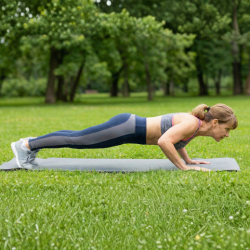
Once you feel stable in this position, you perform the push-up by slowly lowering your entire body as one unit until your chest is a few inches from the floor, then pressing firmly through your palms to return to the start. If a floor push-up feels too taxing, try an “Incline Push-Up” by placing your hands on a kitchen counter or a sturdy table. This reduces the percentage of your body weight you have to lift while still engaging your chest and core.
Finally, incorporate Wall Slides to maintain shoulder health. Stand with your back against a wall and slowly slide your arms up and down into a “Y” shape, which helps counteract the “hunched” posture often associated with aging. As you get more comfortable with the movement, you can add light weights into your routine.
Flexibility and Mobility: The Missing Link
While building strength is vital, muscle health is incomplete without flexibility. As we age, our tendons and ligaments tend to lose some of their elasticity, which can lead to stiffness. Integrating a few minutes of stretching at the end of your routine ensures that your new muscle growth doesn’t come at the cost of your range of motion.
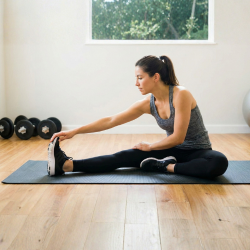
A simple Hamstring Stretch, performed by sitting on the floor with one leg extended and reaching toward your toes, can alleviate lower back pressure. For the upper body, a Doorway Chest Stretch, where you place your forearms on either side of a door frame and lean forward, opens up the chest and improves posture. The goal isn’t to become a gymnast, but rather to ensure your muscles remain supple enough to support your joints through their full range of motion.
Prioritizing Your Protein Needs
If exercise provides the blueprint for a stronger body, protein is the actual lumber and brick needed to build the house. Without a sufficient supply of amino acids, your body cannot effectively repair the micro-tears created during a workout. As we age, our bodies become slightly less efficient at processing protein which means that meeting your daily requirements becomes even more critical.
A solid rule of thumb for muscle maintenance and growth is to aim for roughly 0.5-0.7 grams of protein for every pound of body weight. This is best achieved by distributing your intake throughout the day rather than eating one large protein-heavy meal. Focus on high-quality sources such as lean poultry, eggs, and Greek yogurt, or plant-based staples like lentils and tofu. For those who find it difficult to eat enough whole food, a clean protein powder can bridge the gap. When you prioritize protein, you aren’t just fueling your muscles; you are stabilizing your blood sugar and helping your body recover faster from the stresses of daily life.
The Role of Supplements: Why Creatine Matters
While a balanced diet is the foundation of health, certain supplements offer a significant advantage for muscle preservation. Creatine Monohydrate is perhaps the most researched supplement in the world, and its benefits extend far beyond the weight room.
Creatine works by increasing the body’s stores of phosphocreatine, which helps produce a high-energy molecule called ATP. This allows your muscles to perform better during short bouts of intense activity. For the average adult, this means you can squeeze out one or two more repetitions during your workout, which is often the catalyst for real growth. Beyond pure strength, creatine has been shown to support cognitive health and bone density, making it a powerful tool for aging gracefully. While some people also use nitric oxide boosters to improve blood flow and circulation during exercise, these are generally considered a secondary “extra” compared to the foundational benefits of creatine.
>>>Shop High-Quality Creatine Monohydrate from Research Verified
Conclusion:
Building muscle as an adult isn’t about chasing a fleeting aesthetic or spending your life savings on the latest fitness gadgets. It is a long-term investment in your future self. By focusing on foundational movements like squats and push-ups, you are starting to “future-proof” your body against the natural decline in mobility that comes with age. When you pair these movements with the structural support of high protein intake and the proven performance boost of Creatine Monohydrate, you create a powerful synergy that makes results feel inevitable rather than impossible.
Remember that progress isn’t always a straight line, and you don’t need to be perfect to see improvements. Some days you might only have time for a few wall slides and a quick walk; other days you’ll hit your protein goals with ease and feel strong in your workout. The goal is to stay the course, and make consistent progress. By treating your muscles with the respect they deserve through movement, nutrition, and smart supplementation, you aren’t just adding years to your life; you’re adding life to your years.
YOU DO THE EXERCISE, WE TAKE CARE OF THE SUPPLEMENTS



Comments are closed.