

Remember when you could stay busy all day, go out in the evening, and still have plenty of energy left for whatever came next? These days, perhaps a long afternoon of errands leaves you ready for the couch, or you find yourself needing more time to recover after physical activity.
It’s tempting to dismiss these changes as an inevitable part of getting older. But why does our energy seem to decline with age, even when our daily routines haven’t changed all that much?
The answer involves more than simply getting older. From changes in muscle strength and sleep quality to the way our cells produce energy, several factors can influence how energetic we feel. And scientists have been investigating one particularly interesting compound that may play a role in healthy aging: NMN.
Why Do We Feel Less Energetic as We Age?
As we get older, our bodies undergo biological changes that can make everyday activities feel more demanding.
For one thing, we gradually lose muscle mass and strength, particularly if we don’t exercise regularly. This can make activities such as climbing stairs, carrying groceries, or taking long walks require more effort than they once did. Additionally, our cardiovascular fitness can also decline, causing the heart, lungs, and muscles to not work together as efficiently during physical activity. Meanwhile, changes in sleep patterns can make it harder to get the refreshing rest we need.
But there’s another factor that researchers have become increasingly interested in: how efficiently our cells produce and manage energy.
Every cell in your body requires a constant supply of energy to function. Much of this energy is produced by structures called mitochondria, which convert nutrients from food into a form your cells can use. As we age, changes in mitochondrial function and cellular metabolism can affect this process. That’s where a molecule called NAD+ enters the picture.
What Does NAD+ Have to Do With Energy?
NAD+, (short for nicotinamide adenine dinucleotide,) is a molecule involved in many essential cellular processes, including energy production. Without sufficient NAD+, important metabolic reactions cannot function normally. Interestingly, studies suggest that, in certain tissue, NAD+ availability can decline with age. However, these changes aren’t consistent in everyone.
This discovery has encouraged researchers to investigate whether supporting the body’s NAD+ production could help maintain normal cellular function as we get older. And one of the compounds receiving considerable scientific attention is nicotinamide mononucleotide, better known as NMN.
What Is NMN, and Why Are Scientists Studying It?
NMN is a naturally occurring compound that your body uses to produce NAD+. In simple terms, NMN provides one of the building blocks your cells need to maintain their NAD+ supply, which then triggers energy productions.
Because NAD+ plays such an important role in cellular metabolism, researchers have been investigating whether supplementation with its precursor, NMN, can help support NAD+ levels as we age.
So far, the results have been interesting.
A randomized, placebo-controlled study published in GeroScience in 2024 investigated NMN supplementation in older adults over 12 weeks. Researchers found increased blood NAD+ levels, along with improvements in certain sleep-related measures and findings suggesting a possible benefit for walking performance.
What does this mean for you?
NMN provides a way to supplement a compound involved in your body’s natural NAD+ production. Although scientists haven’t established that NMN consistently improves energy or slows aging in humans, its role in cellular metabolism makes it an interesting supplement for those interested in anti-aging.
Introducing Research Verified NMN+
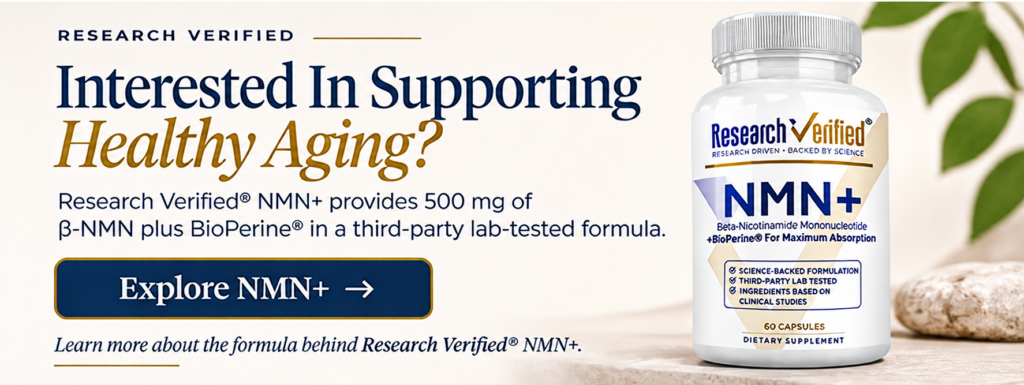
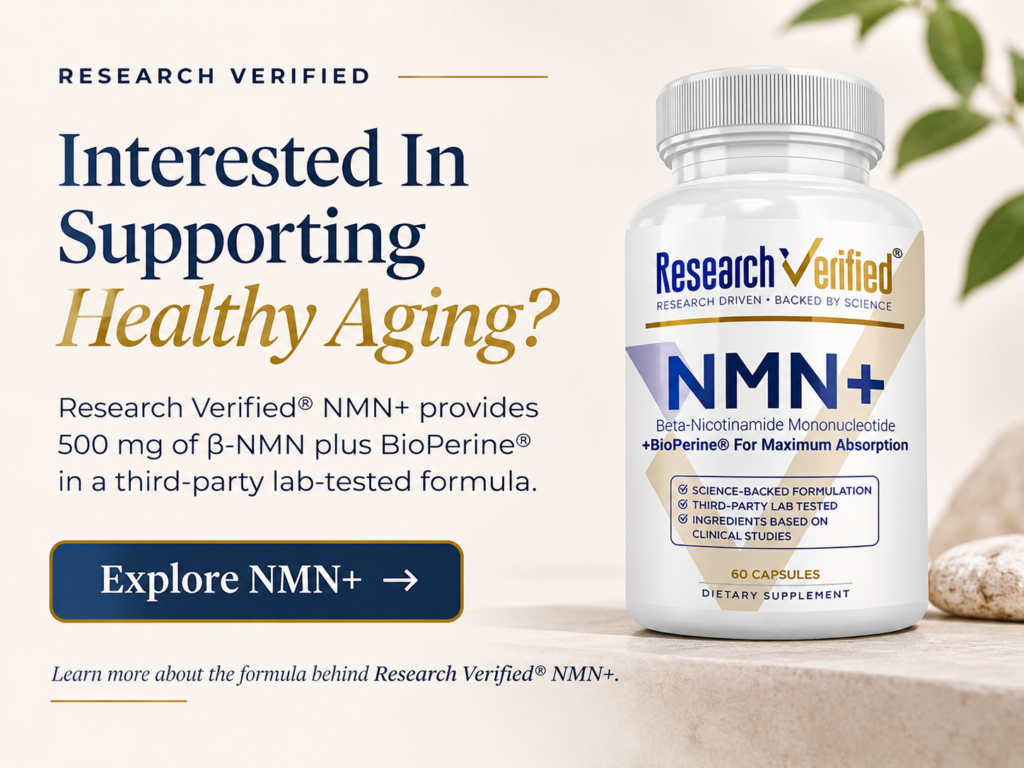
If you’re interested in supporting the cellular processes involved in healthy aging, then the quality and composition of your supplement matter. Research Verified® NMN+ provides 500 mg of beta-nicotinamide mononucleotide (β-NMN) in every two-capsule serving. Beta-NMN is the form used by the body in NAD+ metabolism, and the 500 mg serving is a clinically studied dosage.
The formula also includes 5 mg of BioPerine®, a standardized black pepper extract studied for its potential to improve nutrient bioavailability. In a 2024 human pilot study, researchers compared 500 mg of NMN alone with 500 mg of NMN plus 5 mg of BioPerine. The combination produced 14.6% higher peak serum NAD levels than NMN alone, suggesting that BioPerine may help support the body’s NAD response to NMN supplementation. Although larger studies are needed to confirm these findings, the research provides a promising scientific rationale for combining these two ingredients.
Research Verified NMN+ also offers important quality assurances:
- Third-party lab tested for additional quality assurance.
- Manufactured in the USA under cGMP standards.
- 365-Day Satisfaction Guarantee, allowing you to try the product and if you’re not satisfied then you can get your money back.
Unlike caffeine, which temporarily stimulates the nervous system, NMN is involved in the body’s normal cellular metabolic pathways. It’s not intended to deliver an immediate energy boost, but rather to provide a compound the body naturally uses to produce NAD+.
Interested in the science behind NMN? Explore Research Verified NMN+ and learn more about its formula.
What Else Can You Do to Maintain Your Energy?
While NMN research continues to develop, there are several established ways to maintain your energy and physical function as you age.
- Regular physical activity is one of the most important. Strength training helps preserve muscle mass, while activities such as walking, swimming, and cycling support cardiovascular fitness and endurance.
- Getting enough sleep is equally important. Maintaining a consistent sleep schedule and addressing problems that interfere with restful sleep can make a noticeable difference in how energetic you feel.
- Nutrition also plays an essential role. Your body needs adequate protein, vitamins, minerals, and other nutrients to maintain muscle function and support normal energy metabolism.
And if you’re experiencing persistent, unexplained tiredness, don’t automatically blame your age. Conditions such as anemia, thyroid problems, and sleep disorders can contribute to fatigue and may require medical attention.
The Bottom Line
Feeling less energetic as you get older isn’t necessarily something you have to accept without question. Although aging brings changes to muscle strength, sleep, and metabolism, there are meaningful steps you can take to support your physical function and overall well-being.
Scientists are also continuing to investigate the relationship between NMN, NAD+, and cellular aging. While more research is needed to understand the long-term benefits of NMN supplementation, its role as a precursor to NAD+ has made it an interesting option for people exploring nutritional support for healthy aging.
- Fatigue in Older Adults. National Institute on Aging, National Institutes of Health.
- NAD+ Metabolism and Its Roles in Cellular Processes During Ageing. Nature Reviews Molecular Cell Biology, 2021.
- Ingestion of β-Nicotinamide Mononucleotide Increased Blood NAD Levels, Maintained Walking Speed, and Improved Sleep Quality in Older Adults in a Double-Blind Randomized, Placebo-Controlled Study. GeroScience, 2024.
- Improved Physical Performance Parameters in Patients Taking Nicotinamide Mononucleotide (NMN): A Systematic Review of Randomized Control Trials. Cureus, 2024.
- Oral Administration of Nicotinamide Mononucleotide with Bioenhancer BioPerine® Increases the Serum Concentration of Nicotinamide Adenine Dinucleotide in Healthy Human Volunteers: A Pilot, Open-Label, Cross-Over Study. Advances in Bioscience and Biotechnology, 2024.
Consult a healthcare professional before starting a new supplement, particularly if you take medications or have an existing medical condition.


Comments are closed.