

You know the word.
You can almost hear it. Maybe you remember the first letter. You might even be able to describe exactly what it means.
But the word itself simply will not come out.
Then, 20 minutes later while you are doing something completely unrelated, there it is.
This frustrating experience is so common that researchers have a name for it: the tip-of-the-tongue phenomenon.
Occasional word-finding trouble does not necessarily mean that your memory is failing. In many cases, the information is still stored correctly. The temporary problem is retrieving the exact word when you want it.
So why does this seem to happen more often as we get older, tired, stressed, or mentally overloaded?
The Memory Is There. Accessing It Is the Problem.
Remembering a word is not as simple as opening a file and reading what is inside. Your brain has to move through several steps. You first access the concept you want to express, then retrieve the appropriate word, and finally access the sounds needed to say it.
During a tip-of-the-tongue moment, you often successfully complete most of that process. You know what the word means. You may know how long it is or what letter it begins with.
You just cannot retrieve the complete sound pattern.
Researchers studying adults between the ages of 19 and 88 found that tip-of-the-tongue experiences become more common with normal aging (1). The findings suggested that these moments are closely connected with difficulty retrieving the phonological, or sound-based, information needed to produce the word.
In other words, the word itself may not be gone. The pathway to it is temporarily less efficient.
Why Does It Happen More Often With Age?
Some changes in recall speed are considered a normal part of aging.
According to the National Institute on Aging, older adults may notice that it takes longer to remember certain information. Occasionally forgetting which word to use can fall within normal age-related forgetfulness. (2)
Interestingly, having a large vocabulary does not necessarily protect you from these moments. You may know thousands more words than you did when you were 25 while still finding that certain names or words take longer to surface.
Proper names can be especially troublesome. You might easily remember that the actor you are thinking of played in three particular movies, married another celebrity, and has gray hair, yet still fail to retrieve his name.
That disconnect can feel alarming even when it reflects a retrieval problem rather than lost knowledge.
Stress Can Make Recall Harder
Have you ever forgotten a word during an important presentation, only to remember it immediately afterward?
Stress may be part of the explanation. In an experimental study examining memory under psychosocial stress, researchers found that increases in cortisol were associated with poorer retrieval of previously learned information during the stressful situation. (3)
This may help explain why forcing yourself to remember a word sometimes seems to make the situation worse.
You start thinking:
I know this.
Why can’t I remember it?
What is wrong with me?
Now you are trying to retrieve the word while simultaneously monitoring your failure to retrieve it. Giving yourself a moment and moving on can sometimes be more productive than mentally chasing the missing word.
Poor Sleep Can Affect Your Words Too
Mental sharpness is also sensitive to sleep.
One clinical study examined verbal performance after sleep deprivation and found a significant decline in people’s ability to spontaneously generate words after prolonged sleep loss. (4)
You do not need to stay awake for over a day to notice that your thinking feels different after a bad night. When you are exhausted, conversation may feel less fluid. Concentrating takes more effort. Names and facts that would normally come easily may take longer to retrieve.
If your word-finding problems seem considerably worse during busy weeks or after several nights of poor sleep, improving your sleep may be a more sensible first step than assuming something is wrong with your memory.
>>> Learn more about Research Verified Sleep Aid
What Can You Do to Support Sharper Recall?
There is no trick that permanently eliminates tip-of-the-tongue moments, but several everyday habits support general cognitive health.
- Get enough sleep. Your brain performs differently when it is rested.
- Keep using your vocabulary. Reading, conversations, games, learning and other mentally stimulating activities regularly require you to retrieve information rather than simply recognize it.
- Stay physically active. A large 2024 systematic review and meta-analysis found an association between physical activity and better late-life cognition, including small positive associations with episodic memory and verbal fluency. (5)
- Give yourself cues. Researchers have even demonstrated that hearing the first syllable of a missing word can sometimes help resolve a tip-of-the-tongue state. (6)
- And do not underestimate the basics. Eating a nutritious diet, managing stress and staying socially engaged all contribute to the environment in which your brain has to function every day.
Can A Brain Supplement Help?
Supplements cannot replace sleep, exercise or healthy habits. They also cannot guarantee that you will never blank on someone’s name again.However, people interested in nutritional support for memory, focus and mental clarity often choose to add a well-formulated brain supplement to those habits.
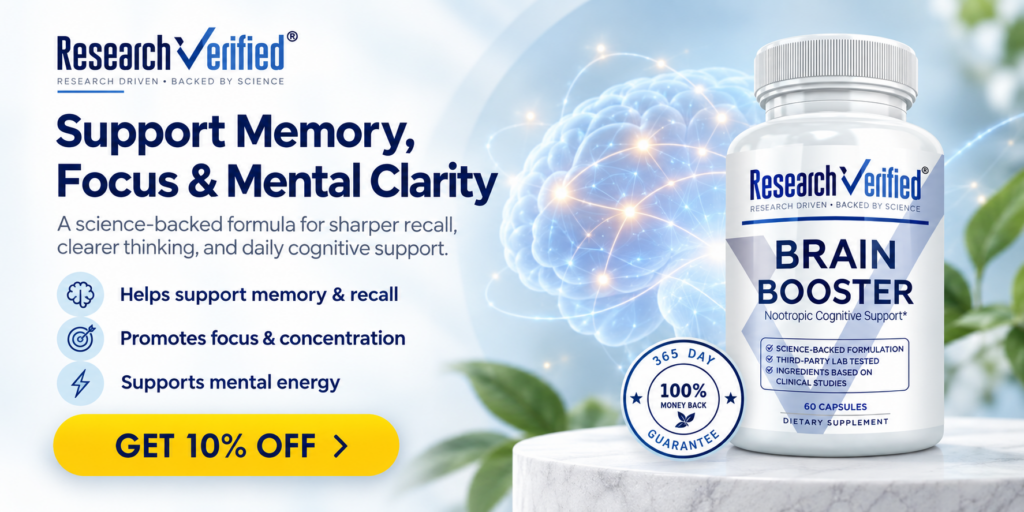
Research Verified Brain Booster was developed as a comprehensive cognitive-support formula, with customers reporting benefits such as less brain fog, better focus and concentration, and easier information processing and recall (7). Its formula supports brain health and mental performance through several complementary pathways. For example, Guarana provides naturally occurring caffeine for alertness and mental energy, Ginkgo Biloba supports healthy cerebral circulation, and Bacopa supports learning, memory, and recall. Other ingredients help support brain-cell energy, neurotransmitter function, neuronal communication, and antioxidant protection, creating a multi-pathway approach to memory, focus, concentration, and mental clarity.
That makes our Brain Booster particularly relevant for people who are not necessarily worried about serious memory loss but have started noticing more of those everyday moments when their mind simply does not feel as sharp or responsive as it once did.
As with any supplement, speak with your healthcare provider before taking Brain Booster, especially if you use medication, have a medical condition, or are pregnant or nursing.
When Should Word-Finding Trouble Be Checked?
Occasionally struggling to remember a word is common. A pattern that begins interfering with your ability to communicate or function normally deserves more attention.
The National Institute on Aging distinguishes between sometimes forgetting which word to use, which can occur with normal aging, and persistent difficulty carrying on a conversation, which may warrant medical evaluation.
You should also speak with a healthcare professional if memory or language changes are getting noticeably worse, affecting familiar tasks, causing confusion, or being noticed regularly by the people around you.
The Bottom Line
That maddening moment when a familiar word disappears is often not a sign that the information itself has vanished. You may still know exactly what you want to say. Your brain simply needs a little longer to retrieve the word.
Age can make these moments more frequent, while stress and poor sleep may make retrieval even harder. To help keep your brain functioning, stay active, sleep well, challenge your mind and practice good overall nutrition. And if you want additional daily nutritional support for memory, focus, and mental clarity, a science-based formula such as Research Verified® Brain Booster can complement those habits.



Comments are closed.